


DYNALAB chooses the JRI-MySirius solution
JRI-MySirius and the new generation of Nano SPY sensors have been chosen by the DYNALAB laboratory to guarantee optimum monitoring of the temperature of its samples, from sampling to analysis!
Comprising nine laboratories, including 3 technical platforms, the DYNALAB group of medical biology laboratories plays a key role in the healthcare chain in the departments of Aube (10) and Seine-et-Marne (77). The Covid-19 pandemic is at the centre of a very busy news cycle, with the group receiving nearly 1,500 patients every day, either directly at its facilities or from the clinics, retirement homes and hospitals it serves nearby.
Through its vast range of analyses, the laboratory processes a large number of samples – the majority of which are heat-sensitive – for which temperature control and monitoring during storage and transport are essential.
“To guarantee this traceability, we wanted a temperature monitoring solution that would also enable us to deploy new connected sensors at our peripheral sites, simply, automatically and securely”, explains Isabelle HILD, Quality and Metrology Manager at DYNALAB Laboratories.
“We had already been using JRI’s Sirius Stockage software and SPY RF temperature recorders for several years. We therefore decided to equip ourselves with the new generation of Nano SPY wireless temperature sensors, and to migrate our measurement monitoring system to the new JRI-MySirius platform.
What advantages do these new solutions offer in terms of the needs and constraints, particularly technical and regulatory, imposed on laboratories? How do the DYNALAB teams use the Nano SPY sensors combined with the JRI-MySirius monitoring platform on a day-to-day basis? Read on…
DYNALAB: 9 medical laboratories and 1 technical centre, ISO 15189 accredited
DYNALAB’s nine medical biology laboratories and technical support centre are located in Troyes and the surrounding area, as well as in the Paris region. Their services range from clinical biology and biochemistry to haematology, immunology and microbiology, molecular biology and reproductive biology.
A member of the LBI – Laboratoires des Biologistes Indépendants – network, DYNALAB employs nearly 130 staff, all of whom are closely involved in the implementation and day-to-day application of an ISO 15189-accredited quality management system, focused on listening to and satisfying customers.
The samples taken by our sampling staff (biologists, assistants and technicians) are sent to the technical platforms for analysis. This multi-site organisation ensures optimum quality of analysis, in particular through perfect control of the conditions under which samples are stored and transported!
Temperature monitoring begins during the storage phase at each of the peripheral sites, where the samples are kept in temperature-controlled equipment, and continues during transport in thermostatically-controlled boxes to the technical platform, where it ends with a short storage phase prior to analysis.
The Nano SPY T1, Nano SPY T2 high-speed digital mini temperature loggers for incubators and Nano SPY T1 for ambient conditions
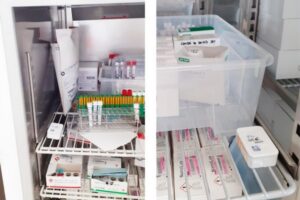
“All our enclosures are now fitted with Nano SPY mini temperature recorders,” explains Ms HILD. “As the vast majority of our peripheral sites have the same type of temperature-controlled equipment, the measurement points are identical.
Nano SPY T1 sensors – installed directly in the refrigerators – are used to monitor the temperature of heat-sensitive products as closely as possible, while the special Nano SPY T2 incubator model – fitted with an external probe, attached to the enclosure using an integrated magnet – is used to monitor the ovens. “The calibration of the Nano SPY T2 sensor, which is restricted to a specific temperature range for this critical equipment, ensures excellent measurement accuracy,” stresses Ms HILD.
Finally, ambient conditions in storage and technical areas are monitored by a dedicated Nano SPY T1 data logger.
Each sensor is ready to use and has a long battery life; its configuration is quickly determined by coloured rings, and its status identified by operating and alarm lights.
The data collected by each of the sensors is then sent automatically by 2.4 GHz radio frequency to the Nano SPY Link transmission module, which is responsible for uploading it to the secure JRI Cloud, to be hosted and used on the JRI-MySirius web application.
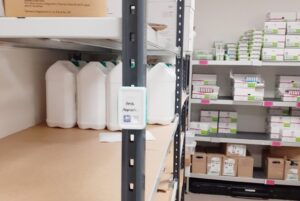
LoRa SPY long-range sensors for transporting samples
“Samples are transported from outlying sites to the technical centre,” adds Isabelle HILD.
“We validate the transport containers twice a year (summer and winter) using LoRa SPY long-range sensors. On arrival at the technical platform, the measurements they have recorded are also automatically sent back to the Nano SPY Link”.
The Nano SPY Link module for data transfer to the JRI-MySirius platform
Using a simple Internet connection, the Nano SPY Link module transmits temperature measurements securely to the JRI-MySirius platform.
The data can then be used and accessed by all teams, 24 hours a day. In the event of a temperature incident, alerts are immediately sent via the platform so that the necessary corrective action can be taken.
The JRI-MySirius Advanced level application complies with CFR Part 11 and includes 36 months of measurement consultation, data archiving, a complete activity log, metrological management of sensors and many other functions designed to meet the quality needs of pharmacists and pharmaceutical wholesalers.
All data is hosted on Microsoft’s ultra-secure Azure servers to meet security requirements. A technical support service is available if required.
Monitoring measurements, configuring sensors, managing alarms, tracking metrological data…: the advantages of the JRI-MySirius application
“JRI-MySirius is a software application that is very user-friendly. When you log on, the alarm chambers and faulty sensors are automatically displayed on the dashboard, making it easy to identify and locate them within the laboratory(ies)”, says Isabelle HILD.
“One of the advantages of JRI-MySirius is that it displays all the laboratories in plan mode, which makes it easy to remember where the sensors are located, as they are discreet and can easily be lost from sight…”.
“The MySirius software can also be used to draw up reports to assess, over defined periods, the statistics on overruns and alarm response times,” adds the Metrology Quality Manager at the DYNALAB laboratory. And, of course, to consult and manage the metrological aspects of the sensors: calibration, verification, mapping, etc.
Ms HILD continues: “Among the other advantages of the JRI-MySirius solution, I’d also mention
the possibility of cascading alarms: this prioritises the means of alerting the system “crescendo”, from the visual alarm, then the audible alarm (light on the Nano Link or its buzzer, LED light on the sensors, etc.), to the SMS or email. These alarms are not simultaneous, but are triggered according to a defined period for each type of enclosure.
programming of alert thresholds and critical alert thresholds, depending on the contents of the enclosures and/or premises, when a risk of impact on products is identified;
easy-to-use, user-friendly interface. New employees, even novices, can be integrated very easily
automatic detection of sensors when they are added or replaced, as soon as they are activated and in the vicinity of the Link;
rapid integration of certificates of conformity, with a copy of the files directly integrated via the serial number of the declared sensor…”.
Simplicity of implementation and use, compliance, savings, time savings…: JRI goes further!
JRI supports the JRI-MySirius solution with a wide range of services: from installation and qualification of the system, to team training, laboratory and on-site metrology, right through to maintenance operations. The DYNALAB laboratory has also signed a maintenance contract with JRI, including hotline assistance, enabling it to contact technical support at any time.
“The mandatory annual Cofrac calibration of the Nano SPY temperature sensors is carried out by rotation with new probes that have already been Cofrac-calibrated, without having to interrupt the monitoring of our equipment”, stresses Mrs HILD. Once a year, a JRI technician visits each site to carry out the work and collect the old sensors. These are checked by JRI metrologists for drift analysis, in accordance with the regulatory requirement of NF EN 15-189, before being recycled by JRI.
The maintenance contracts offered by JRI provide for the interventions required to keep your installation in operational condition: access to the hotline, hardware and software warranty extensions, on-site preventive and corrective maintenance, pre-planned support and technical administration days, etc.
Article written by Solenne Denis and published in La Gazette du Laboratoire No. 276, June 2021.