



The Transfusion Department of General Hospital Gospić provides safe and reliable blood and blood component services to support clinical care across the region.
To meet the strict regulatory requirements of transfusion medicine and protect patient safety, the department deployed 6 Nano SPY sensors from JRI, ensuring continuous, automated blood product temperature monitoring across all critical storage areas.

Context and Challenges: Why Manual Monitoring Was No Longer Enough
Transfusion medicine cold chain requirements are among the most demanding in all of healthcare. Blood and blood components must be stored within tightly defined temperature ranges at every stage —from collection and processing through to storage and distribution. Whole blood and red blood cells require +2°C to +6°C, platelets must be kept between +20°C and +24°C with continuous agitation, and plasma and cryoprecipitate must be stored at −30°C or below.
Any deviation, even brief, can compromise the safety and efficacy of blood products. The consequences are direct and potentially life-threatening for patients. Manual monitoring alone simply cannot provide the level of continuity and traceability that regulators demand.
The Transfusion Department identified five non-negotiable requirements: continuous 24/7 temperature monitoring with calibrated and qualified equipment; immediate alarm triggering when temperatures fall outside defined ranges; clear escalation procedures defining who is notified and how to respond; full data logging and audit-ready reporting to demonstrate regulatory compliance; and seamless integration into existing hospital workflows.
How Did General Hospital Gospić Secure Its Blood Product Cold Chain?
General Hospital Gospić secured its blood product cold chain by deploying 6 JRI Nano SPY wireless sensors across all critical storage areas. Connected to the JRI-MySirius cloud platform, these sensors deliver 24/7 automated temperature monitoring, instant multi-channel alerts, and tamper-proof data archiving ensuring full compliance with the EU Blood Directive (2002/98/EC), Good Distribution Practice (GDP), and ISO 15189.
The JRI Solution: Nano SPY and JRI-MySirius for Transfusion-Grade Monitoring
A Compact, Reliable Sensor Built for Critical Healthcare Environments
After careful evaluation, the Transfusion Department selected JRI’s Nano SPY a compact wireless data logger purpose-built for precise, reliable temperature measurement in sensitive healthcare settings. Its compact design allows discreet, non-intrusive installation in any storage area. Its wireless data transmission feeds directly into the JRI-MySirius cloud platform via RF 2.4 GHz. And its internal memory guarantees zero data loss in the event of any communication interruption a critical safeguard in a 24/7 clinical environment.
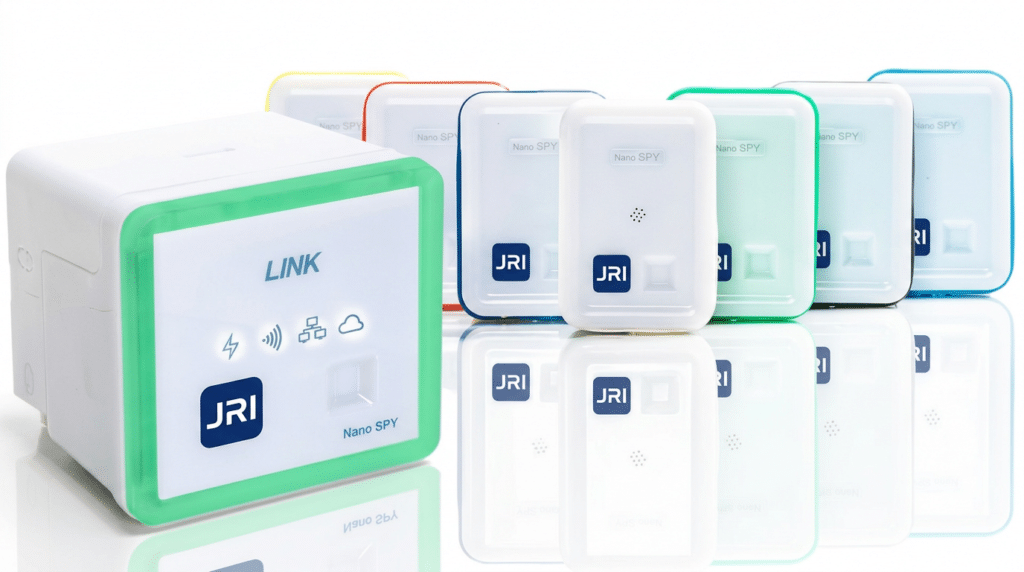
The choice was straightforward, as the department’s own teams confirmed.
“We chose the NanoSPY solution from JRI for its compact design, reliability, and suitability for our specific needs in temperature monitoring.”
— Transfusion Department, General Hospital Gospić
Deployment: 6 Sensors Across All Critical Storage Areas
The installation and commissioning of 6 Nano SPY sensors covered every critical area where blood and blood components are stored. Each sensor operates fully autonomously: continuous automated temperature measurement requires no manual intervention, multi-channel alerts trigger instantly when thresholds are exceeded, and all data is archived securely and tamper-proof on the JRI-MySirius platform.
The JRI-MySirius Platform: Full Visibility and Compliance in One Place
All sensor data flows directly into JRI-MySirius platform JRI’s benchmark cloud software for medical professionals, trusted by over 15,000 organisations worldwide. The result is a single point of control for the entire monitoring infrastructure.
The Transfusion Department gains a real-time dashboard for instant visibility across all storage areas, configurable alarm management with defined escalation procedures specifying who is notified and how, automated audit-ready reports for regulatory inspections, and complete data logging with full traceability of measurements, alarms and corrective actions. The architecture is modular and scalable, ready to accommodate future extensions of the monitoring fleet.
Before / After / Gain
Criteria | Before JRI | After Nano SPY Deployment | Gain |
Monitoring mode | Manual checks, risk of gaps in coverage | Continuous automated monitoring 24/7 | Full continuity, zero blind spots |
Anomaly detection | Delayed detection, dependent on staff availability | Instant alerts when thresholds are exceeded | Rapid response, reduced risk to blood products |
Alarm management | Informal or manual escalation | Configured escalation procedures with defined contacts | Clear accountability, faster corrective action |
Data traceability | Manual logs, risk of gaps or errors | Automated, tamper-proof data archiving | Audit-ready compliance at all times |
Workload | Time-consuming manual temperature checks | Automated transmission, minimal staff intervention | Staff time freed for higher-value clinical tasks |
Scalability | Limited by manual processes | Modular system, easily extended | Future-proof infrastructure |
—
Results and Benefits: Patient Safety Backed by Reliable Data
The deployment of the JRI IoT monitoring solution for blood banks and transfusion centres delivers clear, tangible results. All critical blood product storage areas are now under continuous, uninterrupted monitoring. Temperature deviations are detected immediately, with automated multi-channel alerts ensuring the right person is notified and can respond without delay.
Data logging is complete, tamper-proof, and ready for regulatory audits at any time covering the EU Blood Directive (2002/98/EC), Good Distribution Practice (GDP), and ISO 15189. Beyond compliance, the impact on daily operations is equally significant. Manual temperature checks have been replaced by fully automated transmission, freeing transfusion staff to focus on patient care rather than administrative tasks. And with a modular, scalable platform, the department is fully equipped to extend its monitoring infrastructure as its needs evolve.
Outlook: Calibration Services and Fleet Extension
Building on this first deployment, the Transfusion Department has identified regular calibration services as a priority next step. Ensuring the long-term accuracy of all Nano SPY sensors in storage areas and transport refrigerators alike is essential to maintaining the quality assurance framework the department has built.
An extension of the monitoring fleet to additional storage equipment is also under consideration. JR’is fully equipped to support this next phase.
Ensure the Safety of Your Blood Products with JRI
Do you manage blood products or other temperature-sensitive biological materials? Our experts will help you design a monitoring architecture that meets the strictest healthcare regulations from sensor installation, commissioning and qualification.
Need to speak to a JRI expert about your measurement project?
Find the best solution for your business. Contact a JRI Expert today.
Contact an expert