
Cyberattack on supermarkets: your monitoring probe must be independent of the controller
On 12 October 2026, a massive cyberattack struck the Danfoss refrigeration controllers in more than 300 supermarkets across France. Temperatures soared to 50°C, alarms were disabled, and tens of millions of euros’ worth of goods were destroyed. This unprecedented incident highlights a fundamental principle of cold chain monitoring: the absolute necessity of separating the monitoring system from the control sensor.
What happened on the night of 11–12 October
During the night between Sunday and Monday, hackers remotely took control of the refrigeration control systems manufactured by the Danish company Danfoss, which are installed in hundreds of French supermarkets.
Their modus operandi: to hijack the defrost function – which is normally used for a few minutes a day to remove frost – by forcing it to run continuously with the temperature set at 50°C. The equipment heated up for several hours instead of keeping the goods cold. (Source: BFMTV, 12 October 2026)
The extent of the damage
- At least 300 Intermarché and Netto shops affected (source: RTL / AFP, 12 October 2026)
- Nearly 100 Coopérative U shops, 80 Carrefour shops and 30 Monoprix shops are also affected (source: Ouest-France, 12 October 2026)
- Losses estimated at “tens of millions of euros” nationwide (source: Thierry Cotillard, CEO of Les Mousquetaires, BFMTV, 12 October 2026)
- Fires reported in a number of shops (source: Paris Public Prosecutor’s Office, Europe 1 / AFP, 12 October 2026)
The key issue: When oversight and regulation rely on the same system
Early in the morning, shop staff discovered the damage. In many cases, no alarm had gone off during the night.
The Intermarché in Chauvoncourt confirmed this in its official statement:
“Certain temperature settings were altered, preventing the alarms from triggering as normal.”
— Intermarché Chauvoncourt (source: Est Républicain, 12 October 2026)
Cybersecurity expert Marta Rybczynska, who holds a PhD in network security, also confirmed to the daily newspaper *Sud Ouest*:
“The attackers must have disabled the alarms whilst logged in as an administrator. They then changed the settings afterwards.”
Why didn’t the alarms go off?
The reason is structural. The compromised Danfoss controllers (models AK-SM800, AK-SC355 and AK-SM800A) combine three functions in a single device:
- Refrigerationcontrol (compressors, temperature setpoints, defrosting)
- Alarms (temperature thresholds, technical alerts)
- Monitoring (data history, traceability)
By taking control of this single device, the hackers disabled all three functions simultaneously. The system responsible for raising the alarm was the same one that had just been compromised.
Cybersecurity expert Yassir Kazar sums up the problem perfectly:
“A compromised system does not report that it has been compromised. A standalone thermometer does.”
— Yassir Kazar – cybersecurity expert – CEO of YOGOSHA, 12 October 2026
The solution: monitoring that is completely independent of the control system
At JRI, this principle of separating monitoring from regulation has always been at the heart of our approach. It is a fundamental rule that applies to both static chambers and refrigerated vehicles.
The principle
Your temperature monitoring system must operate on a network that is physically and logically separate from your refrigeration unit control system. The two systems must not share the same hardware, the same communication network or the same power supply.
A monitoring architecture that won’t disrupt your systems
Beyond simply ensuring that monitoring and control are independent of one another, the JRI architecture provides an additional safeguard: our monitoring equipment cannot, under any circumstances, interact with your control systems or your IT infrastructure.
A technical architecture for JRI solutions with no connection to refrigeration control systems
JRI data loggers (Nova SPY, LoRa SPY, Liberty SPY) communicate either via a secure, proprietary radio protocol with a Link, Gateway or NovaCell unit, or directly with our JRI-MySirius application via an independent LoRaWAN or LTE-M cellular network (LoRa SPY and Liberty SPY).
Our Link, Gateway or NovaCell units connect to the JRI-MySirius application either through an independent 4G or LTE-M cellular network, or via an Ethernet connection within your network, using dedicated, secure ports that are open for outbound traffic only.
In all cases:
✅ No hacking of a JRI sensor or data logger can disrupt the operation of your refrigeration systems or any regulation equipment.
✅ When an Ethernet connection is used, it remains strictly limited to dedicated outbound ports.
✅ Deploying JRI data loggers requires no intervention on your refrigeration control system.
This is a fundamental difference from the Danfoss controllers hacked on October 12, whose management interface was directly accessible from the store’s Internet network — an exploitable entry point for attackers.
Secure cloud-based intelligence, sensors kept up to date
The JRI solution’s ingenuity lies entirely in the JRI-MySirius cloud platform, whose data is hosted on Microsoft Azure, which is ISO 27001-certified and authorised for the storage of health data. This infrastructure meets the highest cybersecurity standards on the market.
The JRI-MySirius solution is designed in accordance with the latest international security standards (Azure CIS, NIST SP 800-53 R5, HIPAA HITRUST, FedRAMP and ISO 27001:2013). It is also regularly audited and penetration-tested by specialized companies. In addition, our infrastructure is updated very frequently, at least monthly, to keep pace with evolving cyberattack strategies.
The loggers themselves are regularly updated remotely, without the need for physical intervention on site. Unlike Danfoss controllers, whose outdated firmware had not been updated for years, JRI loggers benefit from a continuous maintenance cycle that ensures their long-term security.
This combination (a dedicated network-based recorder + secure cloud-based intelligence + regular remote updates) offers a level of resilience that traditional control systems – which are often connected to the internet without adequate protection – cannot guarantee.
Static speakers:
Nova SPY range
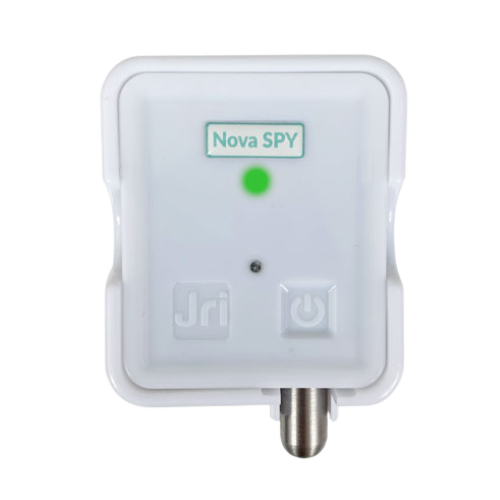
For monitoring cold rooms, refrigerated cabinets, display cases and warehouses, JRI offers the Nova SPY range , which communicates via 2.4 GHz radio frequency using the Nano SPY LINK transmission module, over a network that is completely independent of the refrigeration unit’s controller.
Nova SPY Digital: the multifunctional recorder
The Nova SPY data logger goes far beyond simply measuring ambient temperature. It combines three functions in a single compact sensor:
- Ambient temperature: continuous measurement of the air inside the chamber
- Simulated core temperature: the Nova SPY Digital simulates the core temperature of your products, without the need to insert a probe into each item
- Door-opening detection: via a built-in light sensor, it detects everytimethe door is opened and closed, enabling temperature fluctuations to be linkedtodoor movements
Robust (IP66/IP68), compact and resistant to shocks and vibrations, it operates at temperatures ranging from -40°C to +80°C and has a battery life of up to 6 years. Its food-grade polycarbonate casing is designed to be placed directly inside your enclosures.
What Nova SPY guarantees in the event of the controller being compromised
If the controller is hacked or breaks down:
- ✅ The sensors continue to measure and record temperatures via their own network
- ✅ JRI MySirius detects temperature fluctuations in real time
- ✅ Alarms are triggered instantly via text message, email, phone call or a local siren, and a notification is sent via the mobile app
- ✅ The on-call team steps in before any goods are lost
Refrigerated vehicles:
Liberty SPY
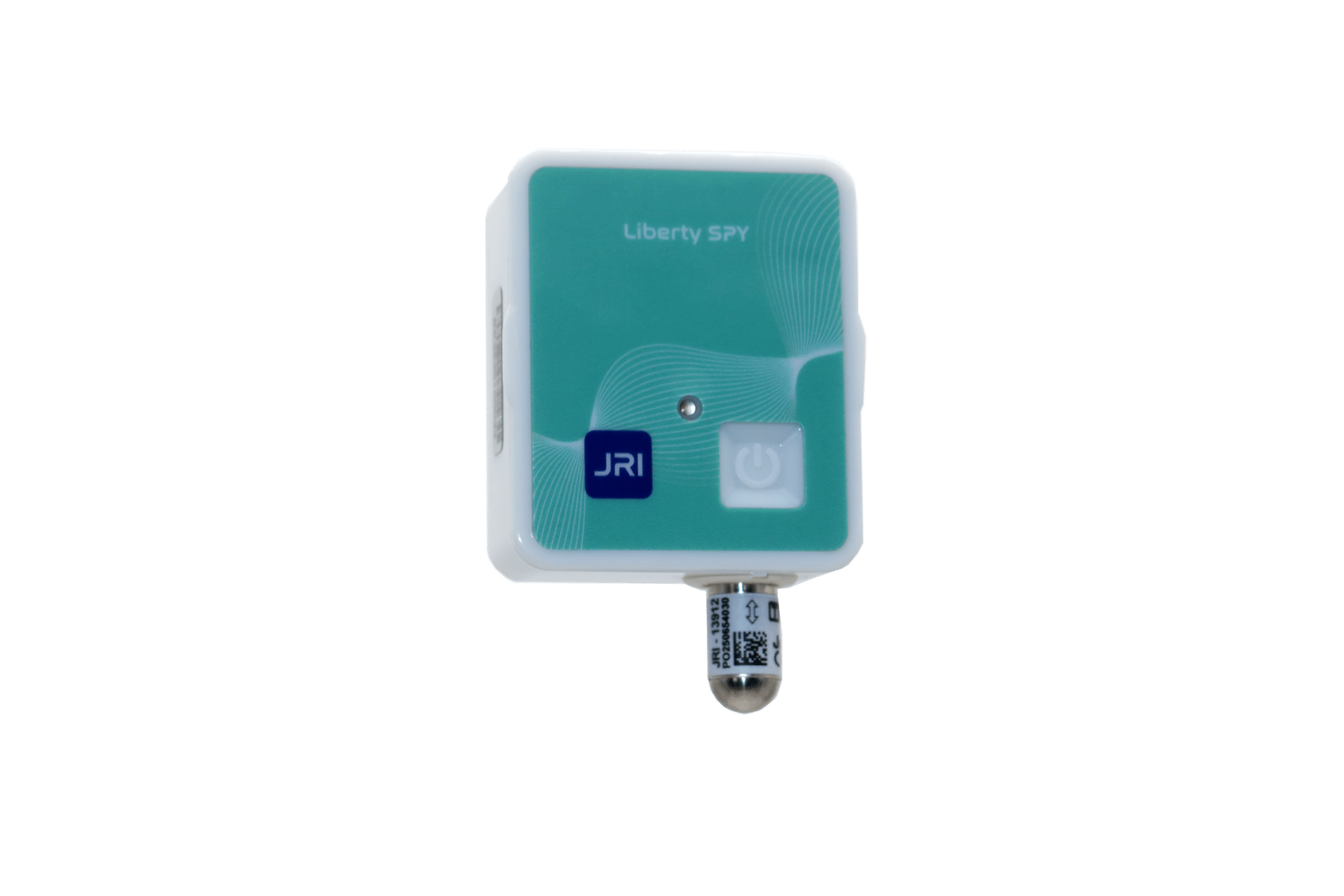
The principle of independence between monitoring and regulation is just as essential in the transport sector. The regulator for the lorry’s refrigeration unit should not be the sole means of ensuring that your goods are monitored during delivery.
Liberty SPY: connected monitoring and real-time alarms
The Liberty SPY cellular data logger is specially designed for refrigerated vehicles. It provides:
- Continuousmonitoring of temperature and humidity in refrigerated vehicles, via a dedicated external sensor
- Door-opening detection to track each stage of the delivery
The Liberty SPY transmits its data via the LTE-M mobile network, which is completely independent of the vehicle’s refrigeration unit. Even if the lorry’s control system is faulty, has been hacked or has simply broken down, the Liberty SPY continues to monitor and send alerts.
Key strengths for the transport sector
- International connectivity: the LTE-M network is available in over 120 countries
- Real-time alerts: via text message, email and notifications on the MySiriusAlert mobile app
- Vehicle independence: the solution adapts instantly when one lorry is temporarily replaced by another
- Simplified metrological management: a sensor rotation system to minimise vehicle downtime
What would have happened with the JRI-MySirius surveillance solution
In the scenario of the night of 11–12 October, a JRI monitoring configuration separate from the Danfoss controller would have changed the outcome:
Event | Without independent oversight | With JRI monitoring |
Hacker takes control of the regulator | ✅ Faulty regulator | ✅ Faulty regulator |
Temperatures are rising to 50°C | ❌ Alarms disabled by the hacker | ✅ Nova SPY / Liberty SPY detect the rise |
Alert sent | ❌ No alerts for hours | ✅ Text message / email / phone call / mobile app notification |
Team intervention | ❌ Discovered in the morning – too late | ✅ Prompt response, stock saved |
Summary | ❌ Total loss of goods | ✅ Loss limited or avoided |
Our recommendations for professionals in the cold chain sector
Looking beyond this incident, here are the best practices we recommend to all operators of refrigeration equipment, whether in static units or in vehicles:
- Keep monitoring and control separate. Your measurement and alarm system must never rely on the same unit as your refrigeration controller.
- Use a dedicated communication network. Monitoring sensors can communicate via an independent network (4G / LTE-M / NB-IoT) or a secure Ethernet connection, rather than through the IT network that controls the refrigeration system.
- Use multiple alert channels. Text messages, email, voice calls, sirens, mobile notifications, and in-cab displays: use a variety of methods to ensure that a breach in one channel does not disrupt the entire information chain.
- Ensure continuous traceability. Your temperature data must be recorded and time-stamped continuously, even in the event of a controller failure. This is a regulatory requirement (HACCP) and provides essential protection in the event of a dispute or audit.
- Apply this principle to refrigerated vehicles as well as to static storage areas. The threat does not stop at the walls of the shop or warehouse. JRI solutions ensure the same level of independence during transport.
This article was published on 13 October 2026. The data and sources cited were up to date at the time of publication.
Would you like to assess the resilience of your facility? Contact our technical teams for a bespoke assessment.